Building Robots - Electrical Drives
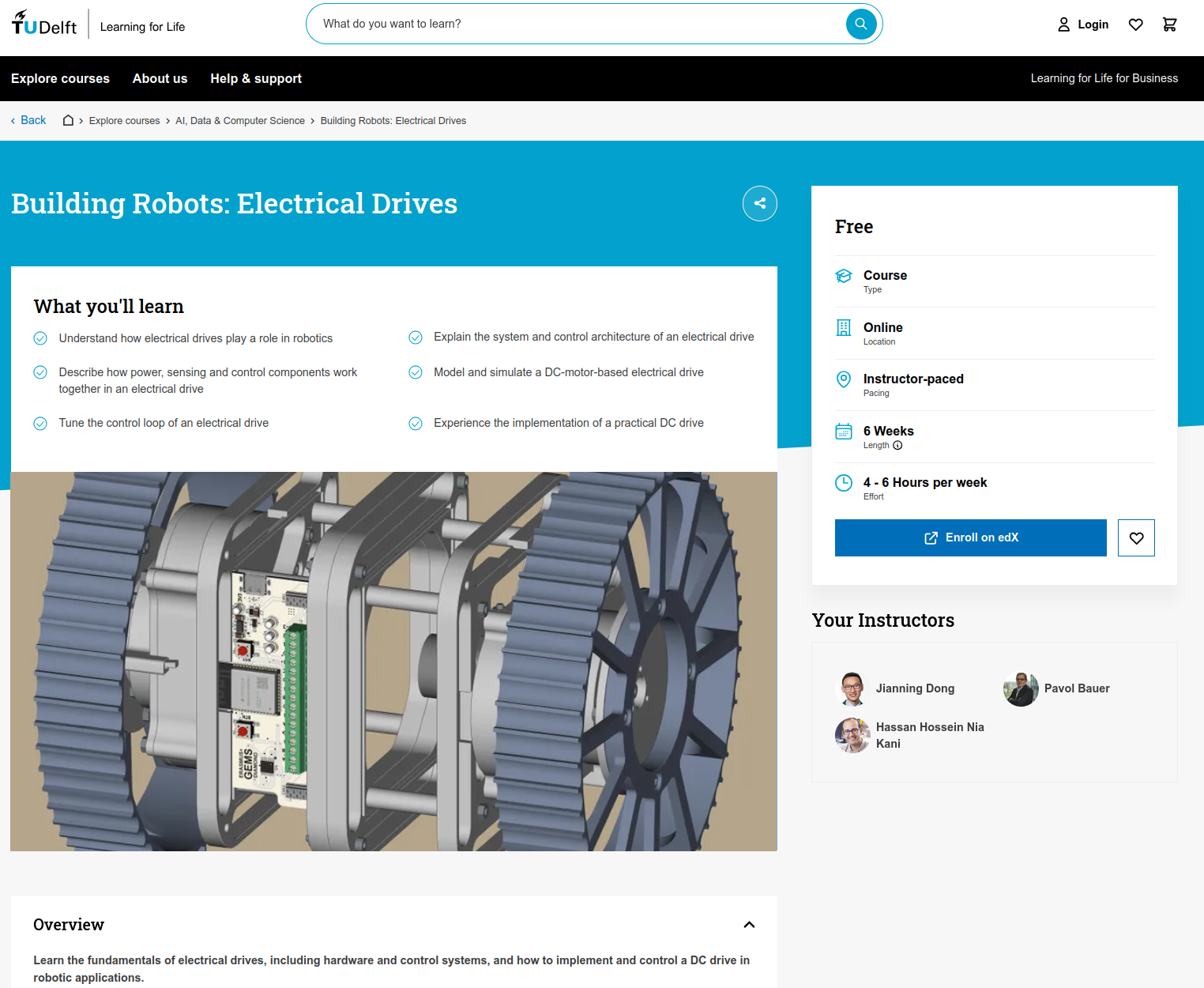
GEMS project created 4 free courses for mechatronics students. The courses are a part of learning program: Building Robots: from Mechatronic Components to Robotics and are hosted by Extension School of TU Delft.
The course Building Robots: Electrical Drives is focused on the DC motor control and is based on GEMS Diamond module. You can access the course by enrolling using free edX account.
Course overview
This course provides the essential knowledge needed to implement the hardware and control loop of an electrical drive in mechatronic systems. Mechatronics is playing an increasingly important role in shaping our world, with robots standing out as some of the most transformative examples. These versatile machines boost efficiency across various domains, from factories and farms to homes and even space exploration. At the core of robotics, electrical drives enable controlled motion, serving as the backbone of these systems.
This course serves as an entry point for implementing electrical drives in robotics. It is designed for engineering students and young engineers with little or no experience in electrical drives, as well as for experienced professionals seeking to expand or refresh their knowledge. The course emphasizes hands-on learning, using practical examples and simulation models to equip you with the skills needed to model, simulate, implement, and test an electrical drive.
The course consists of 7 modules including the introductory module (module 0). In module 1 to 5 you will have access to one lecture video focusing on the theory explanation, one tutorial video introducing relevant background knowledge or practical skills, reading materials including a more detailed reader or simulation tutorials, quizzes to evaluate your study and sometimes an open assignment requiring you to implement a simulation or write some codes. In module 6 you are required to synthesize the knowledge learned in the first 5 modules to implement a DC motor controller.
Learning objectives
So, what will you actually learn in this course? At the end of this course, you will be able to:
- Make critical design choices for a practical electrical drive within given specifications
- Model an electrical drive as a component for system integration in robotics
- Work with other disciplines to develop motion control using electrical drives
- Deploy motor drive hardware and implement the control loop
Course
The course is organized in 7 modules. A brief summary of each unit is presented below. Detailed instructions and resources will be provided during the course.
Getting started with the course
In the Getting Started section you’ll get to know the course structure, get familiarized with the virtual learning environment, complete your profile, meet your fellow students and the moderator. These introductory tasks should be completed in the beginning of the course, after your first login.
Motors and actuators in robotics
In this module you will learn the roles of motors and actuators used in robotics and their operation principles. An overview of basic electromagnetic laws involved will also be provided. After taking the module, you are expected to be able to tell the operation principles of various motors and actuators.
Lecture 1 Motors and Actuators in Robotics
Tutorial 1 Laws of electromagnetism for electrical machines
DC motor structure, principle and Performance
This module will explain the structure and operation principle of DC motor in details. After taking this module you are expected to be able to draw the equivalent circuit of a DC machine, calculate the DC machine performance based on equivalent circuit, and model the dynamics of a DC machine using differential equations. A tutorial on Laplace transformation and its application in dynamic modeling will also be provided. You will be given several quizzes and an open assignment to implement a DC motor simulation at the end of this module.
Lecture 2 DC motor structure principle models
Tutorial 2 Laplace transform and its application
Power converter components, topology and modulation
This module will explain the various types of semiconductors, how the half-bridge is used as a basic building block of power converters and how to realize a four-quadrant DC-DC converter (H-bridge) based on two half-bridges. You will also learn about the pulse width modulation principle. After this module you will be able to calculate the voltage output from given duty cycles of a power converter. A tutorial on loss calculation of power converters will also be provided. You will be given several quizzes and an open assignment to implement a DC-DC converter simulation at the end of this module.
Lecture 3 Power converter components, topology and modulation
Tutorial 3 Losses in a motor drive
DC motor drive system architecture
This module will explain the the hardware architecture of a DC motor drive, explain various feedback sensors involved in DC motor drives and introduce the close-loop control block diagram of a DC motor drive. A tutorial on design considerations for the power converter used in the DC motor drive will also be provided. You will be given several quizzes and an open assignment to implement an open-loop DC motor drive simulation at the end of this module.
Lecture 4 DC motor drives
Tutorial 4 Design considerations for power converters
Close-loop control of DC motor drives
This module will explain dynamics of a DC motor drive system and how PI/PD controllers can be used for close loop control of it. Guideline o how to tune PI/PD controller parameters based on transfer functions and how they are discretized for practical implementation will be explained. A tutorial on how to emulate a DC motor drive using the learned dynamic model is a microcontroller will also be provided. You will be given several quizzes and an open assignment to implement a close-loop DC motor drive simulation at the end of this module.
Lecture 5 DC drive close loop control
Tutorial 5 Implementation of motor model in a microcontroller
Practical implementation of the GEMS Diamond module
This module will explain the the open-source hardware used in the GEMS Diamond module. A tutorial on PID control implementation of motor drives will also be provided. You will be given several quizzes and an open assignment to deploy a close-loop position control in a DC motor drive at the end of this module.
Tutorial 6 PID control of motor drives