Building Robots - Communication Protocols and Hardware
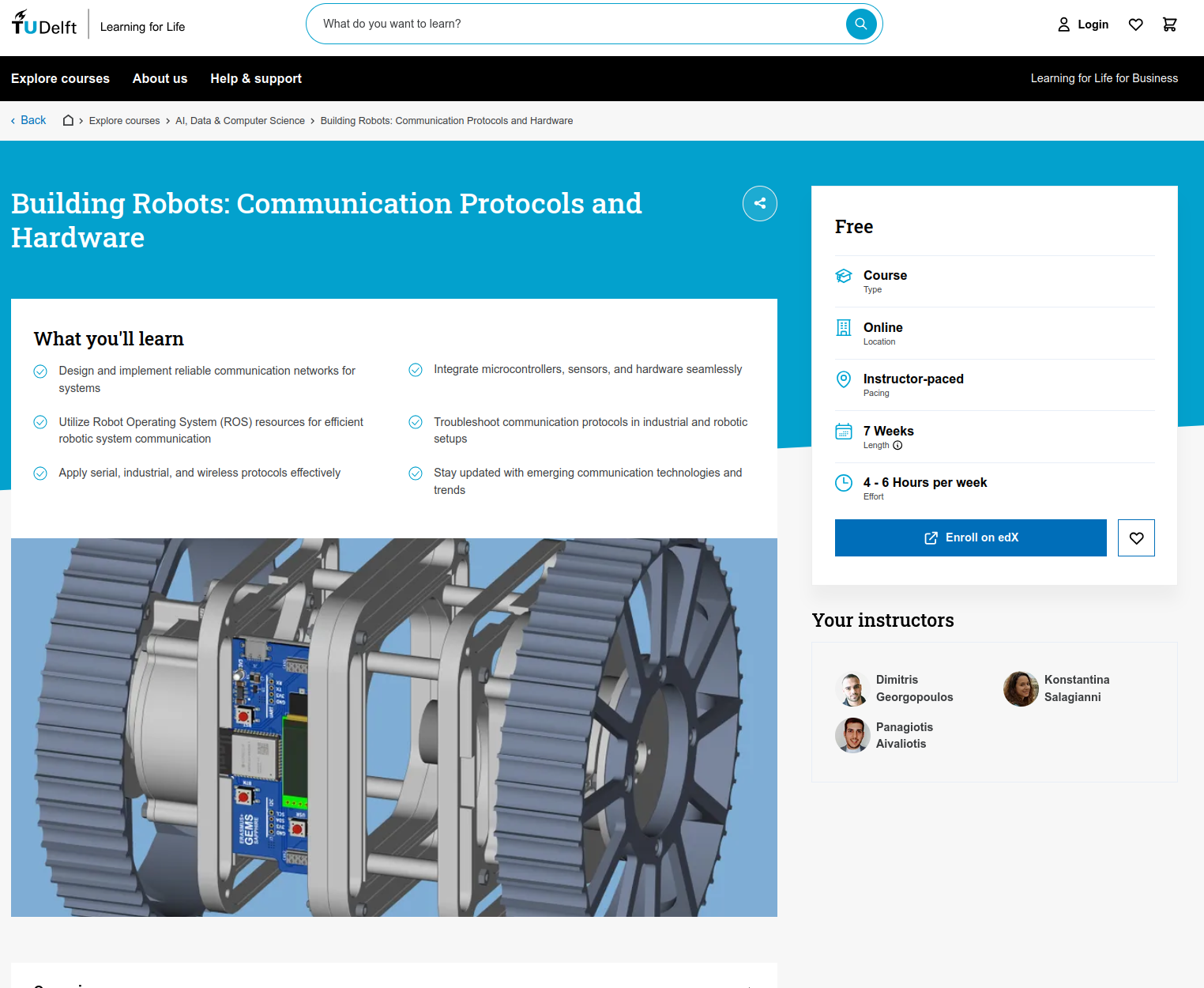
This is one of the 4 free courses at Extension School of TU Delft that was developed under the GEMS project. The courses are a part of learning program: Building Robots: from Mechatronic Components to Robotics.
This course Building Robots: Communication Protocols and Hardware is focused on the communication between mechatronics components and is based on GEMS Sapphire module. You can access the course by enrolling using free edX account.
Course overview
This course provides a comprehensive overview of key communication protocols and essential hardware used in mechatronics, with a strong focus on robotic applications. Mechatronics is playing an increasingly important role in shaping our world, with robots standing out as some of the most transformative examples. These versatile machines boost efficiency across various domains, from factories and farms to homes and even space exploration. At the core of robotics, electrical drives enable controlled motion, serving as the backbone of these systems.
This course is designed for those seeking to deepen their expertise in communication systems within robotics and industrial automation. Geared towards professionals, engineers, and students in fields such as electrical engineering, computer science, and robotics, the course emphasizes practical skills development. A major component is focused on the Robot Operating System (ROS), equipping students with the skills to use ROS’s communication framework to facilitate seamless interaction between software and hardware. This knowledge will empower participants to design effective, adaptable robotic solutions suited to a range of industrial applications.
Learning objectives
So, what will you actually learn in this course? At the end of this course, you will be able to:
- Develop communication firmware and hardware for robotic systems
- Work with other disciplines to realize communication in various robotics applications
- Work with other disciplines to develop motion control using electrical drives
- Deploy ROS in practical robotic systems
Course
The course is organized in 7 modules. A brief summary of each unit is presented below. Detailed instructions and resources will be provided during the course.
Getting started with the course
In the Getting Started section you’ll get to know the course structure, get familiarized with the virtual learning environment, complete your profile, meet your fellow students and the moderator. These introductory tasks should be completed in the beginning of the course, after your first login.
Introduction to Communication Protocols
- Overview of communication protocols
- Communication protocols in robotics an industrial equipment.
- Basic concepts: data transmission, baud rate, protocols
- Types of communication protocols
Fundamentals of Serial Communication
- Understanding Serial Communication
- Overview of RS-232, RS-485, and other serial communication standards
- Configuration and settings for serial communication
Wireless Communication Technologies
- Wireless communication fundamentals
- Wi-Fi, Bluetooth, and other wireless protocols
- Wireless communication in industrial environments
Communication Hardware in Robotics
- Introduction to communication hardware components
- Microcontrollers, microprocessors and communication interfaces
- Actuator control and feedback mechanisms
- Integration of communication hardware in robotic systems
Communication Hardware Design
- PLCs (Programable Logic Controllers) and communication interfaces
- HMI (Human Machine Interface) Devices
- Industrial Networking Hardware
- Best practices on PCB design techniques for industrial communication hardware.
ROS (Robot Operating System) Fundamentals
- Understand what ROS is and why it’s used
- Identify ROS concepts
- Describe the evolution from ROS1 to ROS 2
- From a basic mental model of how robots use ROS
Sustainable management of mechatronics hardware
- Understand the enviromental impact of mechatronics system
- Introduce circular economy principles in enginnering design
- Identify sustainable design strategies for electronics and prototyping
- Promote responsible use and End-of-life Handling of Educational Hardware