Building Robots - Sensors and Data Acquisition
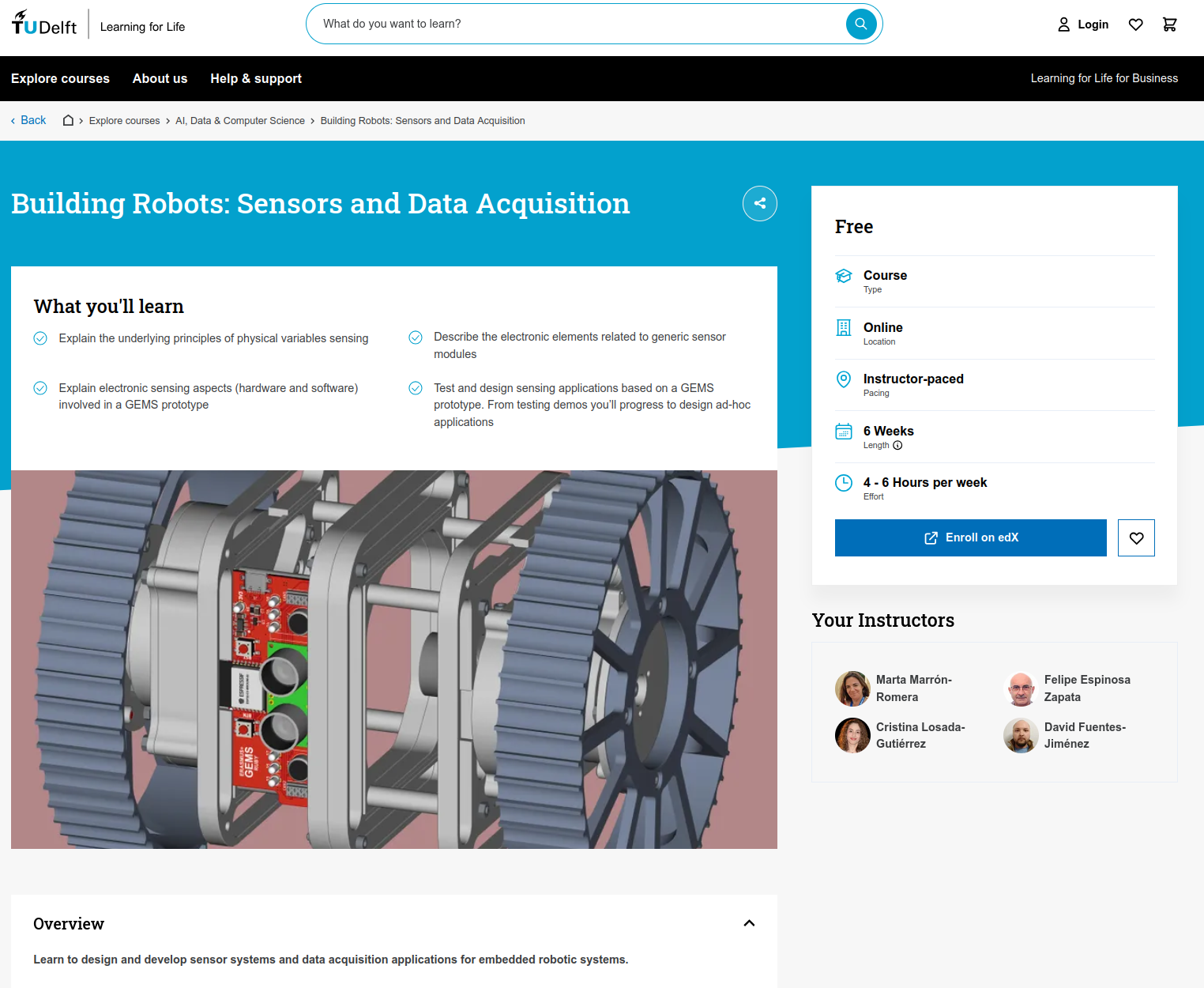
GEMS project created 4 free courses for mechatronics students. The courses are a part of learning program: Building Robots: from Mechatronic Components to Robotics and are hosted by Extension School of TU Delft.
The course Building Robots: Sensors and Data Acquisition is focused on sensors and is based on GEMS Ruby module. You can access the course by enrolling using free edX account.
# Course overview
This course provides the essential knowledge needed to understand and implement electronic sensor modules typically used in mechatronic systems. Mechatronics is playing an increasingly important role in shaping our world, with robots standing out as some of the most transformative examples. These versatile machines boost efficiency across various domains, from factories and farms to homes and even space exploration. Sensor modules are fundamental part of these systems to perceive the working scenario and to close the required control loop.
This course serves as an entry point for implementing sensor modules in robotics. It is designed for engineering students and young engineers with little or no experience in this field , as well as for experienced professionals seeking to expand or refresh their knowledge. The course emphasizes hands-on learning, using practical examples and simulation models to equip you with the skills needed to model, simulate, implement, and test an electronic sensor module.
The course consists of 5 modules. In each of one you will have access to one lecture video focussing on the theory explanation, one tutorial video introducing relevant background knowledge or practical skills, a more detailed reader, quizzes to evaluate your study and sometimes an open assignment requiring you to implement a simulation or write some codes.
Learning objectives
So, what will you actually learn in this course? At the end of this course, you will be able to:
- Understand the role of electronic subsystems typically implemented in sensorial modules for mechatronic prototypes
- Simulate the behaviour of electronic components as part of electronic sensor modules.
- Make critical decisions for sensing developments in mechatronic systems
- Interact with other disciplines to tackled with global robotic applications
Course
The course is organized in 5 modules. A brief summary of each unit is presented below. Detailed instructions and resources will be provided during the course.
Getting started with the course
In the Getting Started section you’ll get to know the course structure, get familiarized with the virtual learning environment, complete your profile, meet your fellow students and the moderator. These introductory tasks should be completed in the beginning of the course, after your first login.
Introduction to sensing technology
This module reviews general aspects of sensing, sensor classifications, and monitoring and control applications.
Lecture 1 Introduction to sensing technology
Electronic support for sensing
This module addresses the basic architecture of a sensorial subsystem, the different types of sensors, and aspects related to calibration and measurement error evaluation.
Lecture 2 Electronic_support_for_sensing
Acquisition and processing
This module reviews the main characteristics of an acquisition system, as well as aspects related to signal discretization. Besides, examples of acquisition and processing tasks are described in this module.
Lecture 3 Data_acquisition
Practice hardware and software issues for sensing
This module describes and applies the Charlieplexing technique using the Ruby card, as well as the concept of distance measurement based on ultrasound sensors.
Tutorial LED visualization using Charlieplexing
Tutorial Ultrasound distance measurement
Acoustic applications based on Ruby card
This module addresses the sound signal acquisition using the Direct of Arrival detection technique, and the digital processing using microphones as sensorial source. With this support, ad-hoc acoustic applications will be designed through the two microphones available in the mentioned electronic card.
Tutorial Analog to digital conversion
Tutorial Sound source localization